
Are your surveys capturing clear signals or just tidy noise? Close-ended questions promise speed, comparability, and clean data, yet their power depends on precise design and disciplined analysis. In practice, many teams rely on them by default and miss subtle trade-offs that affect validity and insight. This article brings a sharper lens to close-ended questions in research, so you can use them with intent rather than habit.
You will learn when close-ended formats outperform open responses, how to craft options that minimize ambiguity, and how to select scales that fit your constructs. We will examine wording, option balance, order effects, and the role of pretesting. You will see how coding choices influence distributions, how to detect and reduce satisficing, and how to align question structure with the analyses you plan to run, from descriptive summaries to chi-square tests and logistic models. We will also map common pitfalls, such as forcing false dichotomies, overlooking mutually exclusive categories, and misusing neutral points. By the end, you will know how to design, field, and analyze close-ended items that produce reliable, decision-ready findings.
Understanding Close-ended Questions
What close-ended questions are and common formats
Close-ended questions constrain respondents to predefined options, which standardizes answers and simplifies analysis. The core formats include multiple choice, yes or no, and Likert scales. Multiple-choice can be single response or multi-select, for example, “Which channels influenced your purchase? Email, Search, Social, Referral,” with an optional “Other” to capture edge cases. Yes or no, also called dichotomous, is best for binary states such as “Did you complete onboarding within 7 days?” Likert scales measure intensity on an ordered scale, for example, “Strongly disagree” to “Strongly agree.” For a deeper overview and additional formats like ranking and rating scales, see this guide to formats of close-ended questions.
Why they matter for quantitative insight
The primary purpose of close-ended questions is to capture clean, comparable data that supports statistical testing and robust decision making. Because responses are standardized, researchers can run cross-tabs, track key metrics over time, and model outcomes with confidence intervals. This structure also improves data reliability by reducing ambiguity in interpretation, which is crucial for segment-level comparisons and trend analysis. In market research, close-ended data supports quick prioritization of product improvements and positioning decisions. For applications and examples, see how close-ended items power quantitative market research.
Efficiency, clarity, and speed
Close-ended questions are faster for participants, which often boosts completion rates and shortens field time. The predefined options reduce cognitive load and clarify meaning, which improves data quality and lowers breakoff risk. On the analysis side, structured responses can be processed at scale, enabling rapid dashboards, significance testing, and automated alerts. Practical tips: keep Likert scales to 5 or 7 points, ensure options are mutually exclusive and collectively exhaustive, randomize option order to minimize order bias, and include “Not applicable” to avoid forced noise. This structure also pairs well with AI workflows, since platforms like Revolens can transform high-volume close-ended responses into prioritized tasks, SLAs, and ownership, while using AI to flag anomalies and synthesize themes from any complementary open-text fields.
Role in Quantitative Research
Why close-ended questions dominate quantitative studies
Roughly 90 percent of quantitative surveys rely on close-ended items, primarily because standardized options accelerate fieldwork and analysis. Predefined responses can be coded instantly, which supports fast turnaround on large samples and reduces human coding error. The format is also easier for participants, so completion times drop and response rates rise, yielding more statistical power from the same budget. For teams synthesizing at scale, AI platforms now process thousands of responses in minutes, surfacing distributions and anomalies without manual effort. These advantages, combined with lower interpretive bias from free-text coding, explain their prevalence in measurement-focused research, as summarized in this close-ended questions overview from Qualtrics.
How they enable hypothesis testing and validation
Close-ended data maps cleanly to statistical tests. Binary or categorical items support chi-square tests for association and logistic models; Likert-type scales can be summarized as means for t tests or fed into ordinal or linear regressions, depending on assumptions. Suppose you hypothesize that a redesign lifts satisfaction. You can compare top-two-box rates pre and post using a two-proportion z test, or model the effect while controlling for segment. Standardized wording and options enable replication across waves or markets, which is essential for validity checks and robustness testing. Transparent use of AI for imputation and quality checks further strengthens the audit trail.
Statistical value and precision in practice
Because options are unambiguous, measurement error and missingness typically fall, which tightens confidence intervals and improves effect-size estimation. Numeric coding enables fast construction of indices and reliability checks across items, then tracking with control charts over time. Actionably, use balanced, clearly labeled scales, pretest to remove overlapping categories, and run power analyses to set sample sizes by smallest detectable lift. With Revolens, teams can connect statistically significant shifts, for example a 6 point rise in retention intent, to prioritized tasks for product, support, and marketing in real time.
Current Trends: Mobile Integration and AI
Mobile integration for close-ended questions
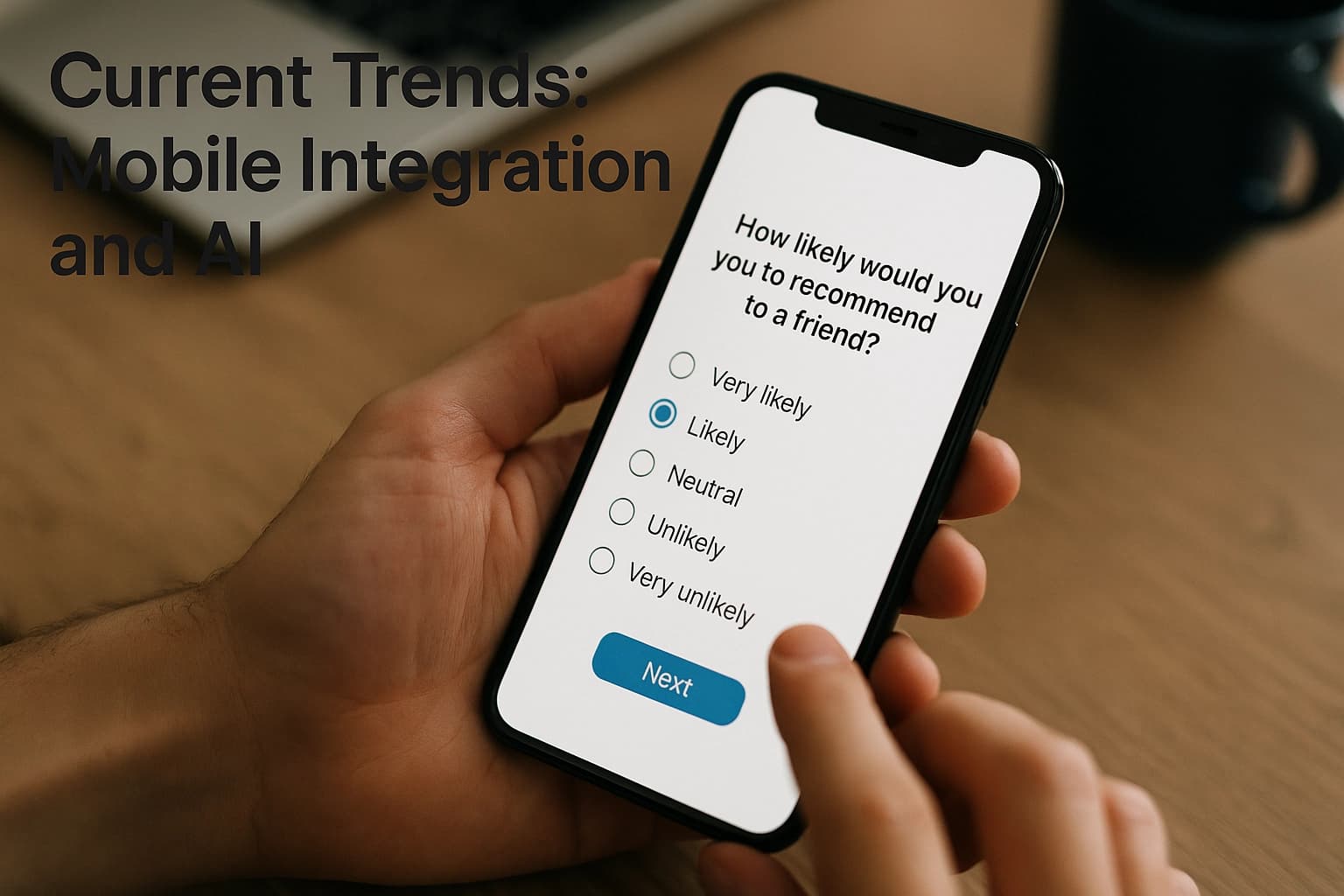
Smartphone-first participation demands surveys that feel native on small screens. For close-ended questions in research, use responsive, single column layouts and avoid wide grids that require zooming or horizontal scroll, which increases abandon rates. Proven mobile practices include concise multiple choice options, large tap targets, and progress cues; The Logit Group details several mobile-first tactics that reduce drop-off and errors Mobile-first survey design practices. Keep sessions short; industry guidance suggests optimizing to 5 to 12 minutes to sustain attention, especially on phones online survey best practices in 2025. For analytics, pre-code options with consistent labels so mobile responses flow cleanly into downstream tables and dashboards.
AI automation of close-ended data evaluation
AI now compresses analysis timelines by processing thousands of survey responses in minutes, then surfacing patterns humans can verify. For close-ended data, models can auto-generate frequency tables, run significance tests, flag straightlining or improbable combinations, and impute missing values to protect trend integrity. They also cluster respondents, score sentiment attached to comments, and populate cross-tabs that analysts can refine. Transparency matters, so disclose AI use and quality checks, and log model versions alongside code frames. Tools that support conversational collection can lift engagement while preserving the simplicity that makes close-ended questions drive higher response rates.
Mixed-methods momentum with close-ended cores
Researchers increasingly pair a close-ended backbone with targeted probes to improve inference. Adaptive designs trigger a brief open-ended follow-up only when a rating is extreme or a checkbox pattern suggests friction, which balances depth with speed. AI assists by routing, coding, and merging modalities so teams can see quantified incidence alongside verbatim explanations in a single view. In practice, platforms like Revolens turn close-ended signals from emails, chats, and surveys into prioritized tasks, then enrich them with AI-coded context, shortening the loop from insight to action.
Advantages: Efficiency and High Response Rates
Faster to field and finish
Close-ended questions in research compress respondent and researcher time. By replacing free text with predefined options, teams routinely cut survey completion time by 40 to 50 percent. In practice, a product satisfaction check can drop from six minutes to three by using a 5 point scale and single choice lists with skip logic. Fieldwork accelerates because validation and quotas are simpler when answers are constrained. With structured responses streaming in, Revolens converts selections into prioritized tasks in real time, eliminating manual triage.
Higher completion, 60 to 70 percent response rates
Structured formats are easier to answer, which lifts participation. Customer panels and touchpoints that use one click ratings and multiple choice items routinely land 60 to 70 percent response rates, above surveys dominated by open text. The cognitive load is lower and pages advance faster, both of which reduce abandonment. A common pattern is an email pulse with three buttons that records the answer instantly, often achieving mid 60s completion. To maximize this effect, keep options concise, avoid grid matrices, and include a neutral option to prevent forced responses.
Analysis in minutes, not days
Uniform answer codes make analytics dramatically faster. With close-ended items, cleaning, recoding, and cross tabulation are automated, producing outputs about 30 percent faster than mixed surveys. Large samples with thousands of cases can be processed in minutes by AI while preserving audit trails. Revolens uses these standardized outputs to cluster themes, quantify impact, and push ready to act tickets to the right teams the same day. For smoother pipelines, map option labels to backlog tags, limit lists to 5 to 7 choices, and reserve an Other write in only when necessary.

Navigating Limitations and Solutions
Known limitations to account for
Close-ended questions in research can compress nuance into rigid options. Respondents often face predefined lists that miss the texture of their experiences, leading to shallow or incomplete signals. Studies caution that the format can introduce option framing effects and force-fit choices when an adequate alternative is missing, which elevates measurement bias and satisficing risk. See the discussion of limited depth and response-option bias from LIS Academy on choosing question types and format selection. Practitioners also note that unexpected or emerging themes are often lost when only fixed categories are offered, reducing discovery value, as summarized in AWA Digital’s guide to close-ended questions. On mobile, these effects can be amplified if long grids or crowded lists push respondents toward the first acceptable option.
Hybrid designs for depth without survey fatigue
A practical remedy is to pair structured items with targeted opportunities for elaboration. Add an optional text probe after outlier ratings, for example, after NPS detractors or CSAT below 6, to capture root causes in respondents’ words. Include an Other, please specify choice for key multiple-select lists where coverage error is likely. Limit free-text prompts to two or three high-impact moments to preserve speed, since close-ended items still drive higher completion rates. AI can then code these qualitative snippets at scale, clustering themes and sentiment in minutes, a capability demonstrated across modern survey analysis tools. This approach preserves the analyzability of close-ended data while preventing blind spots that occur when nuance is filtered out.
How Revolens AI optimizes structure and clarity
Revolens strengthens this hybrid model from design to analysis. During authoring, its AI flags ambiguous wording, double-barreled items, and leading options, then recommends clearer phrasing and balanced scales tailored to your audience’s reading level. It simulates respondent paths to suggest skip logic, for instance, If CSAT ≤ 6, ask Why did you rate us lower today?, and proposes concise follow-up probes. At runtime, Revolens automatically randomizes option orders where appropriate, monitors missingness, and imputes minor gaps to protect data integrity. On the back end, it codes open-ended text, merges it with close-ended signals, and outputs prioritized, actionable tasks for product and service teams. Teams gain the speed of close-ended questions in research without losing the insight density stakeholders need to make confident decisions.
Implications for Businesses and Survey Platforms
How businesses leverage close-ended questions for customer feedback
Companies rely on close-ended questions to capture fast, comparable signals at scale. Multiple choice, rating scales, and yes or no items quantify satisfaction, feature adoption, and pain points in a way that is easy to benchmark across cohorts and over time. Because response is quick and simple, close-ended formats tend to lift completion rates, which improves sample reliability and speed to insight. See the evidence that these items are quicker for participants and often boost response rates in HubSpot’s overview. Teams then track KPIs like CSAT by channel, NPS by segment, or feature usefulness by plan tier, and can run lightweight experiments, such as variant pricing or onboarding prompts, with clean metrics. In practice, an NPS item, a 5 point ease of use scale, and a reason code list after a cancellation can map neatly to product, support, and pricing decisions.

From feedback to tasks with Revolens
Close-ended questions in research produce structured labels that AI can route immediately. Revolens applies this advantage across every feedback surface, from emails and support notes to surveys and chat messages, turning signals into clear, prioritised tasks that teams can act on instantly. For example, a spike in “checkout error” selections can be grouped, scored by volume and sentiment, and dispatched to commerce owners, while “delivery delay, yes” responses can create follow ups for logistics. Modern AI can process thousands of responses in minutes, clustering themes and detecting sentiment patterns, which shortens the time from insight to action. As a best practice, disclose when AI is used for analysis and routing, and retain human review for sensitive cases.
Business impact of streamlined feedback
Streamlined feedback loops expand coverage to real time channels, including physical touchpoints with feedback terminals, which capture quick ratings at the moment of experience. Pair closed items with selective open prompts to add context, a practice outlined in this survey guide. Organizations see faster resolution cycles, fewer duplicate investigations, and clearer accountability when every signal becomes a task with priority, owner, and next step. To operationalize, instrument closed items at key moments, define thresholds that trigger task creation, set SLAs by severity, and monitor response to action latency alongside NPS and churn.
Key Findings
Usage prevalence and efficiency
Close-ended questions in research remain dominant due to efficiency and reliability. A PubMed study comparing formats found surveys using closed-ended prompts achieved 67% completion versus 44.7% for open-ended. Their predefined options lower cognitive load and standardize coding, which raises response rates and compresses time to insight. At analysis, AI platforms can process thousands of responses in minutes, surfacing themes, outliers, and sentiment with minimal human effort. For practitioners, this translates into shorter fieldwork windows, earlier readouts, and cleaner datasets ready for modeling.
How Revolens operationalizes feedback
Revolens turns structured survey signals, plus emails, tickets, and call notes, into prioritized tasks that product and CX teams can execute. Close-ended items power this pipeline, for example severity, frequency, impact scores, and category selects become machine readable fields that drive automated routing. Revolens aggregates evidence across channels, validates with anomaly detection, and then generates actionable backlog entries with owners and due dates. Teams avoid manual triage, and response cycles shift from reactive reporting to continuous delivery of fixes and improvements. Because governance matters, Revolens supports audit trails, role based access, and transparent annotations that document how AI summarized and prioritized feedback.
The accelerating integration of AI in survey design
Survey design itself is becoming AI assisted, from adaptive skip logic to chatbots that lift engagement and quality relative to static forms. AI also improves questionnaire design, predicts drop-off, imputes missing data, and auto-codes open text, which complements the speed of close-ended questions. Best practice now includes disclosing AI usage and models, monitoring bias, and aligning consent language with data processing. A practical pattern is to pair scaled questions for benchmarks with one targeted open question, then let AI cluster themes for decision making. Organizations that combine these methods see faster signal detection and tighter loops from customer voice to shipped change.
Conclusion: Actionable Insights
Why double down on close-ended questions
Close-ended questions should anchor your research strategy because they generate clean, comparable data that is easy to analyze and defend. Their simplicity boosts response rates, especially on mobile, which shortens field times and improves sample quality. With standardized scales, AI can process thousands of responses in minutes, rapidly surfacing themes, sentiment, and anomalies for faster decisions. This structure also supports reliable trend tracking across waves and channels. Paired with transparent AI practices and clear disclosures, teams preserve data integrity while moving at operational speed.
Action steps and AI acceleration
Start with a question bank audit, map each KPI to one close-ended item, for example a 5‑point CSAT, and standardize labels across surveys, emails, and in‑product prompts. Pilot on mobile with a small sample to validate option coverage, add “none of the above” and one optional text box that AI can code. Randomize non-ordinal lists, cap surveys at 90 seconds, and schedule post-launch quality checks. Connect these signals to Revolens, ingesting surveys, chat logs, and emails to auto-create prioritized tasks, route owners, and track SLAs. Enable sentiment and theme dashboards, missing data imputation, and document AI usage for stakeholders. This turns structured feedback into continuous, accountable action.